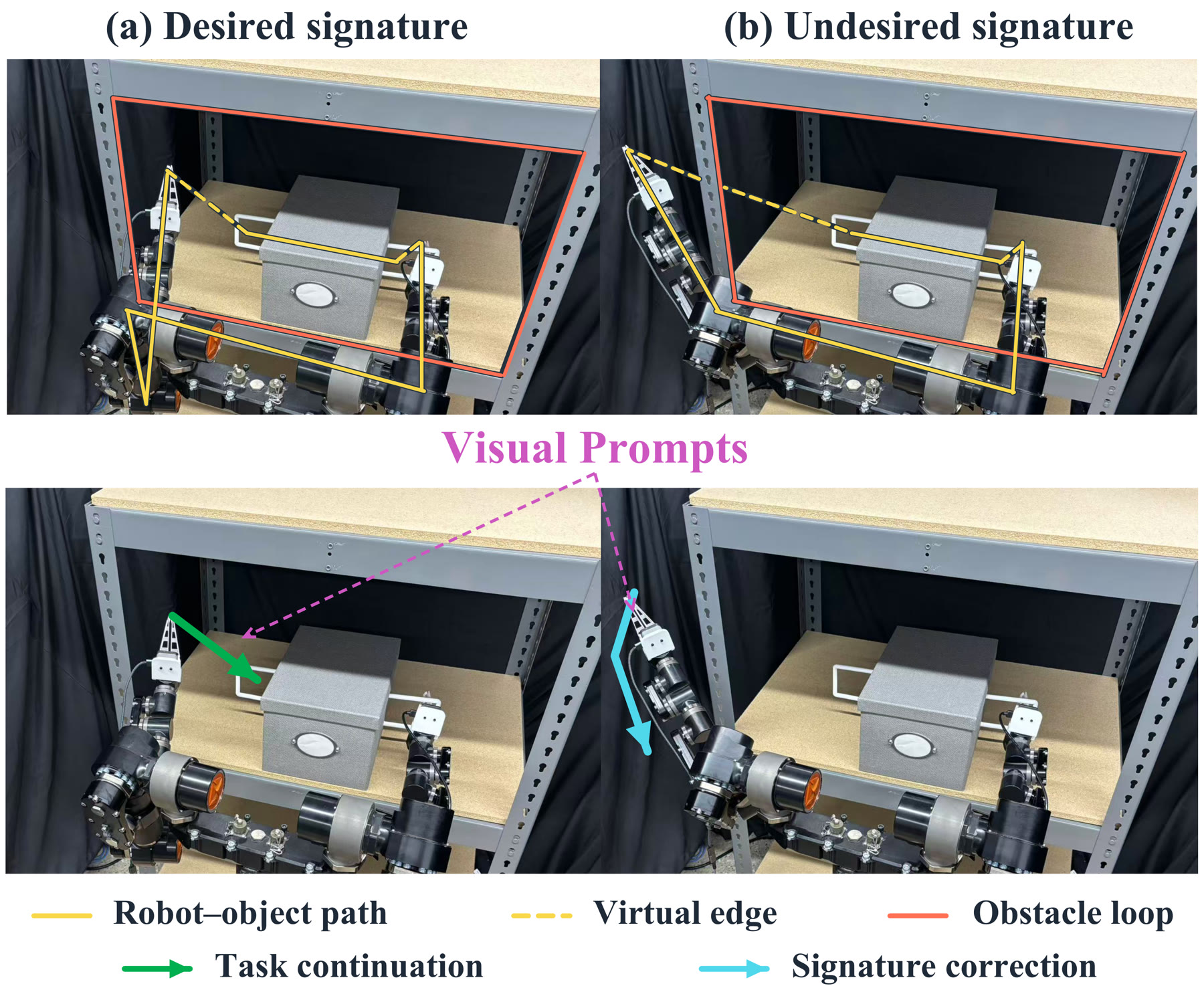
Vision-language-action policies can struggle with manipulation tasks involving complex obstacle geometries because they operate under partial observability. Similar visual observations or robot configurations can require qualitatively different actions, a distinction that can be quantified using topological signatures.
Motion planners can reason about these signatures when environment geometry and object states are known, but this information is often unavailable at deployment. We address this gap with a topology-guided visual-prompting framework that uses simulation-based planning to augment a nominal demonstration dataset and provides vision-based guidance at deployment.
Our method uses a Gauss-linking-integral topological signature to augment VLA fine-tuning data with trajectories that correct signature mismatches and resume task execution. A VLM predicts signatures from live camera observations and end-effector waypoints that are rendered as visual prompts for the VLA. Across three simulated bimanual tasks and a real-world box-pickup task, our method outperforms a VLA fine-tuned only on nominal demonstrations and a VLM-prompting baseline. On hardware, it improves task success by 40 percentage points over the strongest baseline.
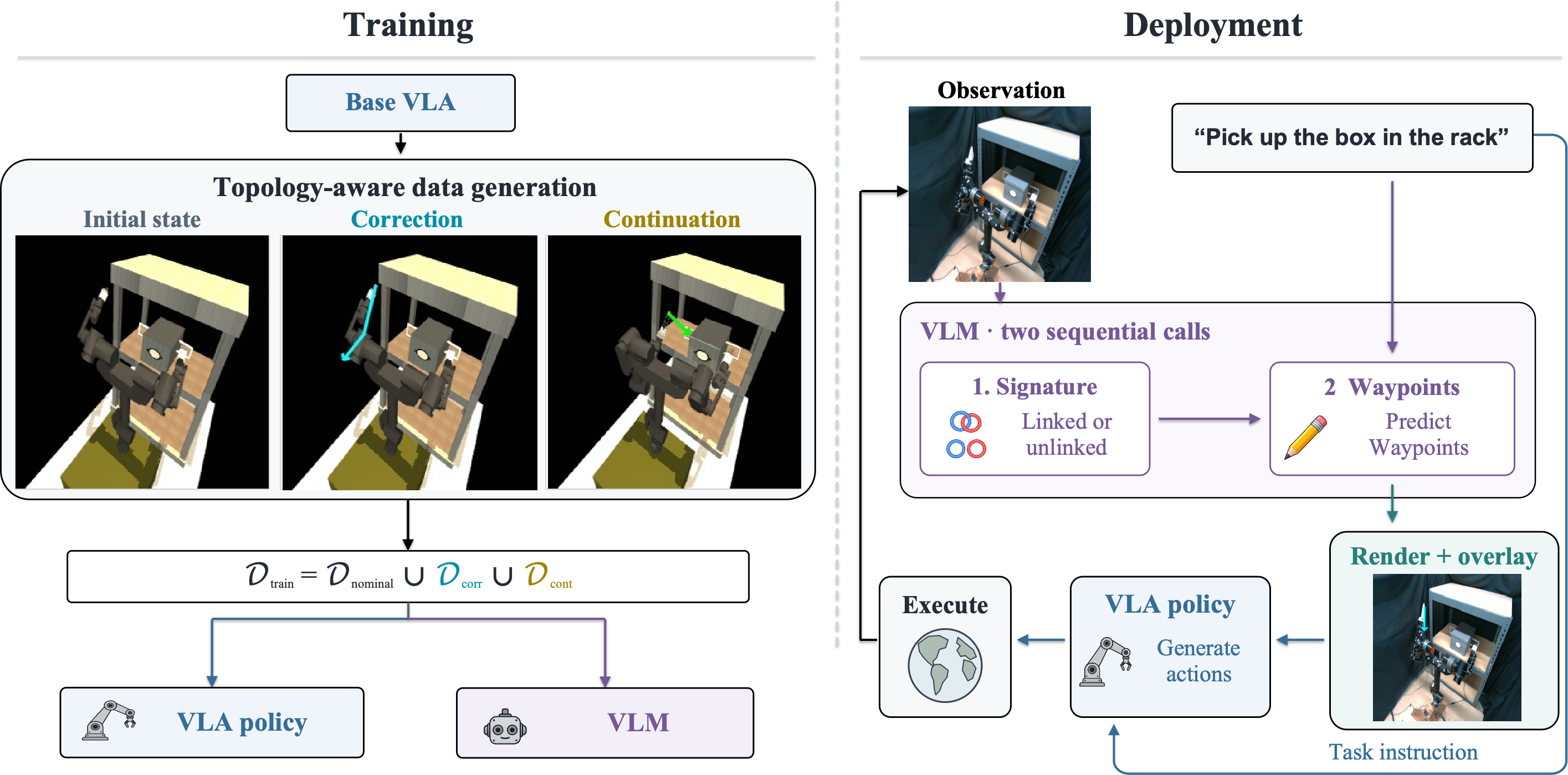
During training, privileged simulator geometry is used to generate signature-correction and task-continuation trajectories. Their projected end-effector paths supervise a VLA and a VLM. At deployment, the VLM predicts the current topological signature and image-space waypoints, which are rendered on the observation as a visual prompt for the VLA. The guidance is updated after every action chunk.
Task success across two VLA backbones. Each setting uses 50 Rope Pulling, 100 Cable Threading, or 100 Box Pickup trials.
| Task | Method | VLA backbone | |
|---|---|---|---|
| π0 | π0.5 | ||
| Rope Pulling | Base Policy | 70 | 52 |
| PEEK | 54 | 50 | |
| Ours | 66 | 64 | |
| Cable Threading | Base Policy | 49 | 47 |
| PEEK | 13 | 20 | |
| Ours | 71 | 77 | |
| Box Pickup | Base Policy | 31 | 45 |
| PEEK | 57 | 66 | |
| Ours | 84 | 82 | |
Task-success rates using the π0.5 backbone.
| Method | Rope Pulling | Cable Threading | Box Pickup |
|---|---|---|---|
| Full Method (Ours) | 64 | 77 | 82 |
| No Visual Prompting | 52 | 69 | 75 |
| Task-Continuation Data Only | N/A | 24 | 54 |
N/A indicates that the Task-Continuation Data Only ablation is not applicable to Rope Pulling because the task requires no signature correction.
Removing VLM-generated prompts while retaining the same topology-aware training data reduces success across all three tasks, indicating that the VLM helps guide the VLA during execution. Using only task-continuation data causes larger drops on tasks requiring signature correction, showing that topology also directs data generation toward relevant recovery states.
Rope Pulling
No signature correction
Cable Threading
Correction to hv = 1
Box Pickup
Correction to hv = 0
| Method | Task success (%) | hv-correction success (%) |
|---|---|---|
| Base Policy π0 | 20 | 30 |
| PEEK | 3 | 20 |
| Ours | 60 | 83 |
Thirty real-world trials. All methods use the same real-world adaptation protocol.